Allotment garden – February

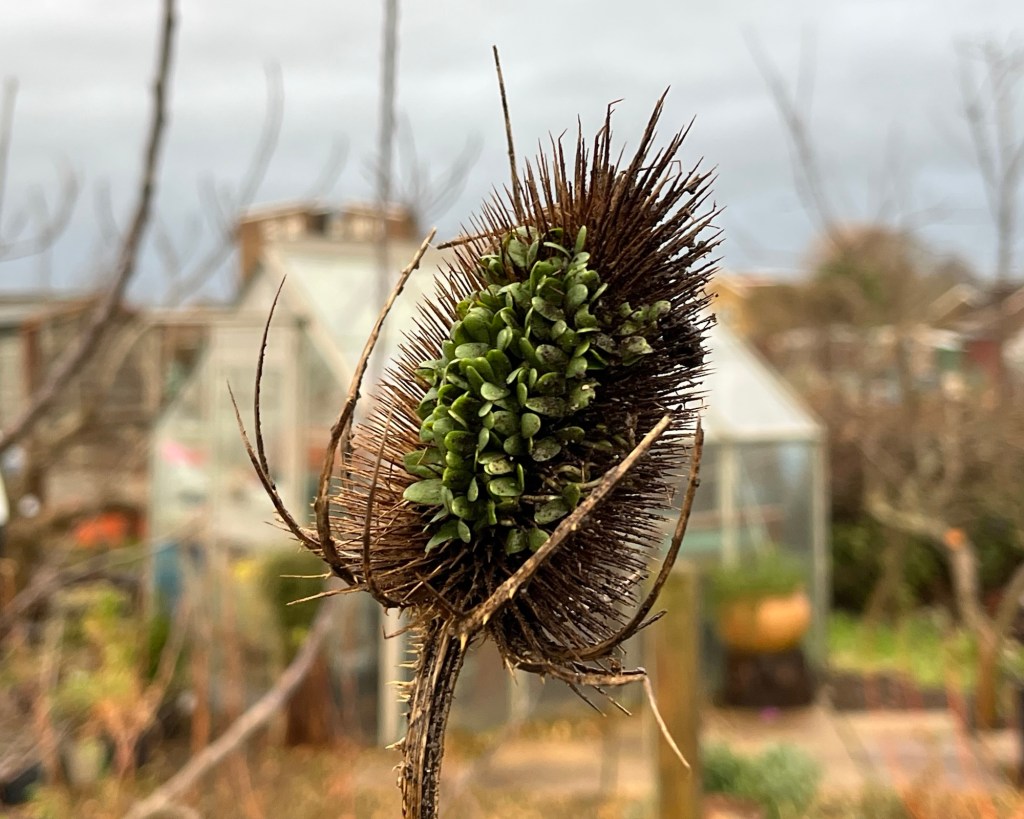
In prolonged mild damp weather Dipsacus fullonum seeds can germinate before vacating the seed head.

In my context (southern UK) winter work is so important if you want to stay on the front foot with your garden or allotment plot. This is the time when nature’s pace slows, I won’t say when nature sleeps as is the popular imagination for there is always movement, and so time for the gardener to take advantage and get ahead. If there is a gardener’s time to slow (in the UK at least) it’s in September when things are at their peak and the seasons are beginning to switch with the autumn and winter ahead. As for the gardener’s time to sleep, well I’m not sure there is one. But in February, despite the unappealing weather, I aim to be as busy as possible with garden tasks. This includes the tidying tasks (greenhouse, shed, pot store) and layout updates (new patio area, dressing paths, relocating plants). I tidy away some of the browns that haven’t aged so well and that are obscuring emerging greens, even as the act of this type of tidying has become stigmatised, although perhaps for good reason (respecting natures cycles, understanding biodiversity, redefining acceptable aesthetics). I realise again in my (local) travels I’ve collected too many plants that are now hanging around in pots (which creates work) and vow to limit this acquire first think second approach I’ve been impulsively taking up to this point. If you love plants for their variety, as I do, then pretty much all plants have an appeal and can bring joy making it hard to say no to the slip towards chaos. Thankfully the chaos doesn’t feel good and provides the check I need (again). But what does feel good is giving away plants to people who express interest or as conversation presents opportunity. In my own experience of this, gifted plants can acquire a special type of value and meaning which becomes part of the garden as it evolves.

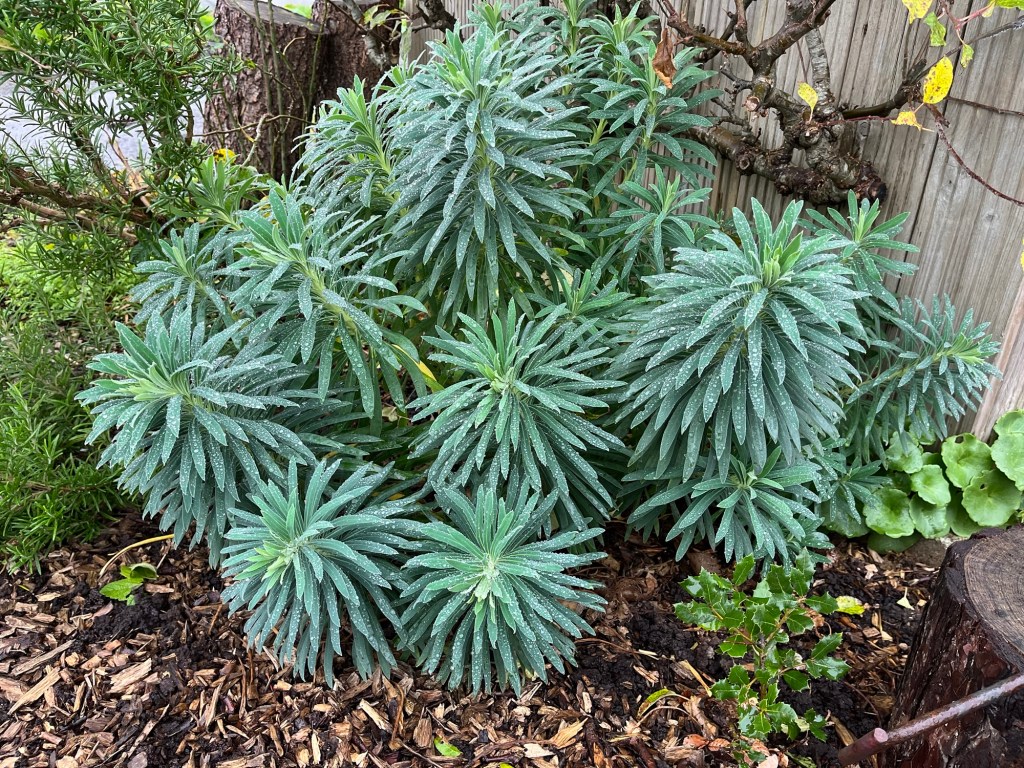
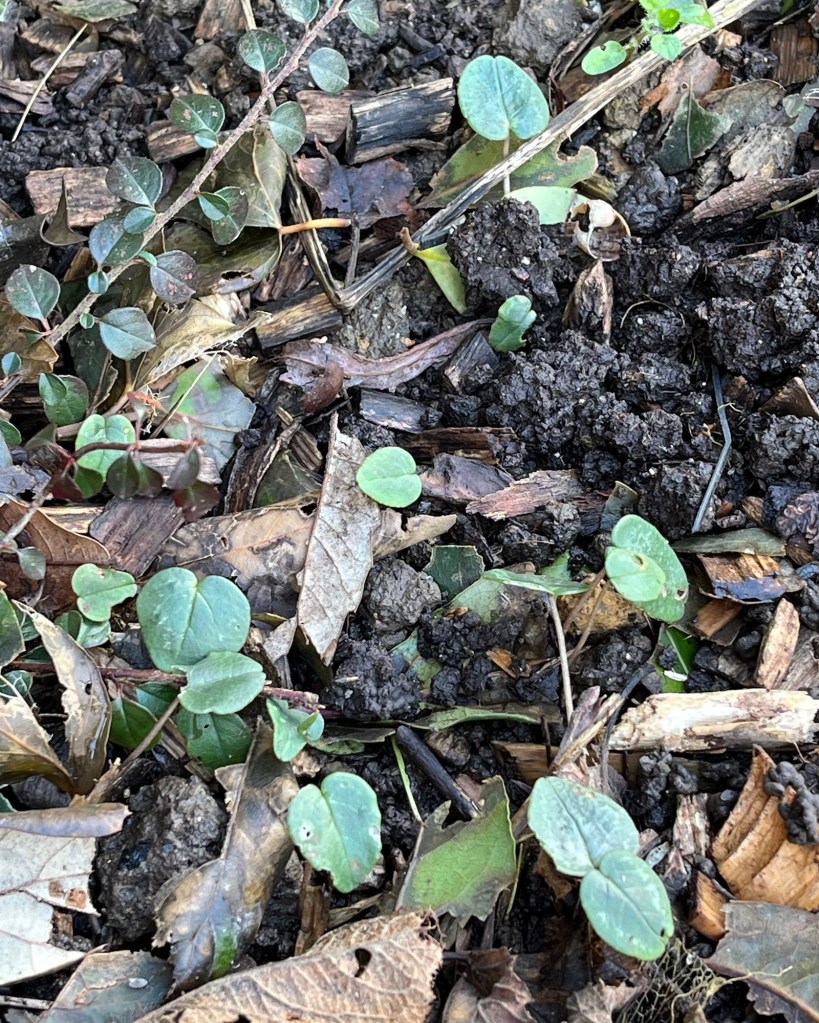
On the whole it’s been pretty mild as Februarys go, I see Dipsacus fullonum (Teasel) seeds germinating whilst still inside the seed heads suggesting mild damp conditions have been persistent. There’s also noticeable progress through the month as crocus, primula and daffodil bring in colour. Like January, February can be bleak, the garden can look like it’s been gutted, but the likes Euphorbia characias wulfenii and its plant partner Umbilicus rupestris are looking particularly good individually and together (see photo) all month as they prepare to flower in early spring. February also seems to be when seedlings of Cyclamen hederifolium show themselves and I’m pleased to see them starting to move about the place.

I added a few perennial plants here and there, some autumn flowering asters, a cerise geranium Geranium psilostemon, the long flowering and semi evergreen Geum coccineum ‘Queen of Orange’ and Phlomis russeliana to accompany an existing Pennisetum grass. Two years ago I sowed seed of Hippophea rhamniodes (Sea buckthorn, a remarkable deciduous shrub) after reading about its array of medicinal and nutritional credentials. The plants grew well but the area in which I wanted to plant several of them together, as male and female plants are needed to get a good crop of nutrient rich berries, was in use for something else (‘storing’ a pile of scrap wood). But with that now cleared I was able to plant out six plants with the hope that they will grow up quickly and bear fruit. Alarmingly I discovered that it’s listed on Schedule 9 of the UK Wildlife and Countryside Act as an invasive non-native species, it being an offence to plant or cause it to grow in the wild. With my allotment plot being one of 400 in the heart of the large town I live in hopefully the chances of an escape are minimal. But if a bird should swallow a berry and relieve itself somewhere distant and rural could an invasion have begun? Am I being irresponsible?

Evergreens Euphorbia characias wulfenii and Umbilicus rupestris looking comfortable in February.
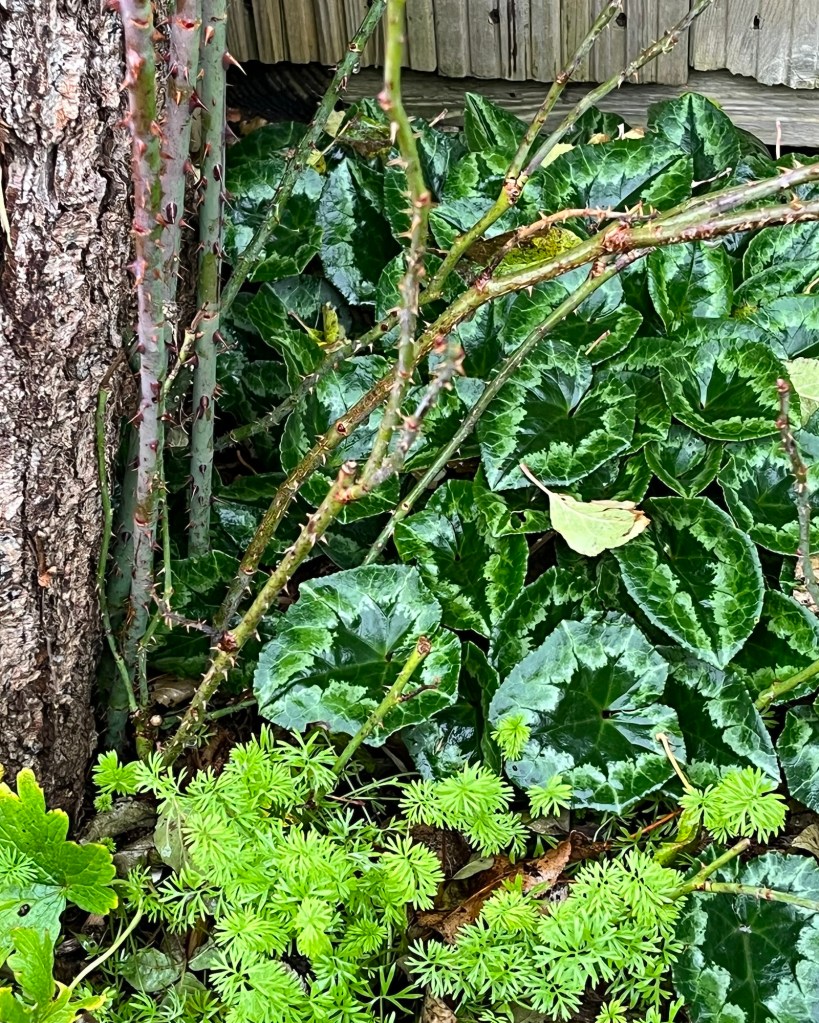
Seedlings of Cyclamen hederifolium make an appearance during February.

Allotment garden – January

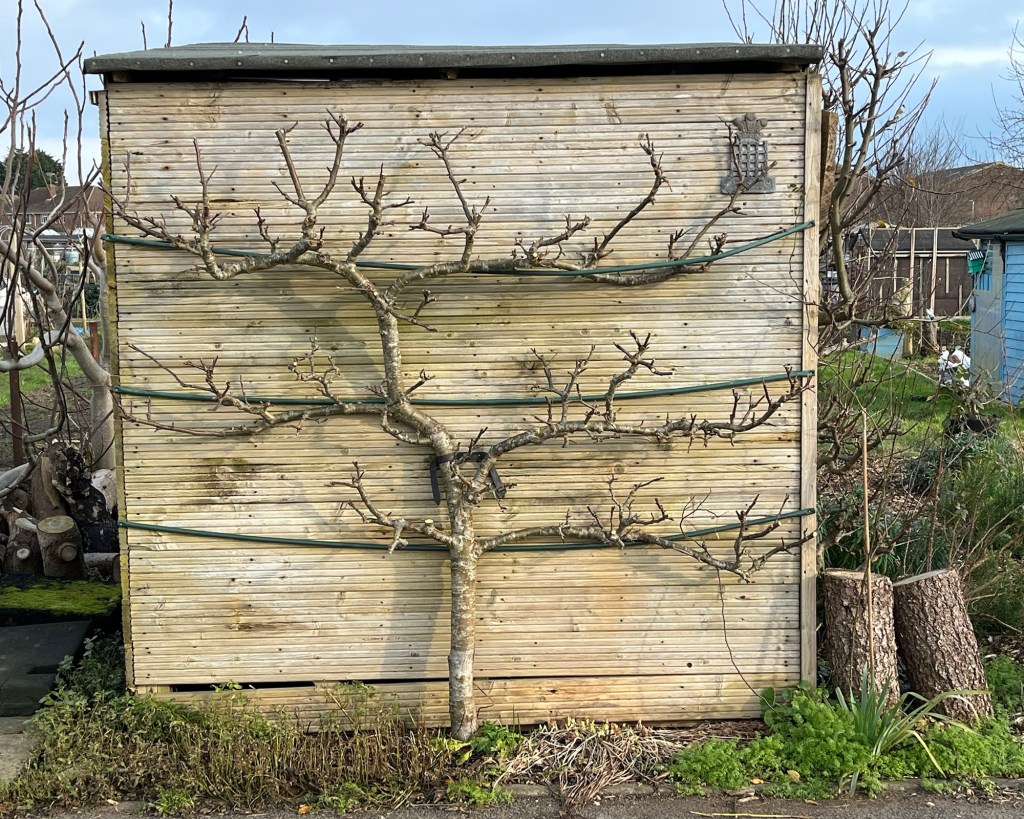
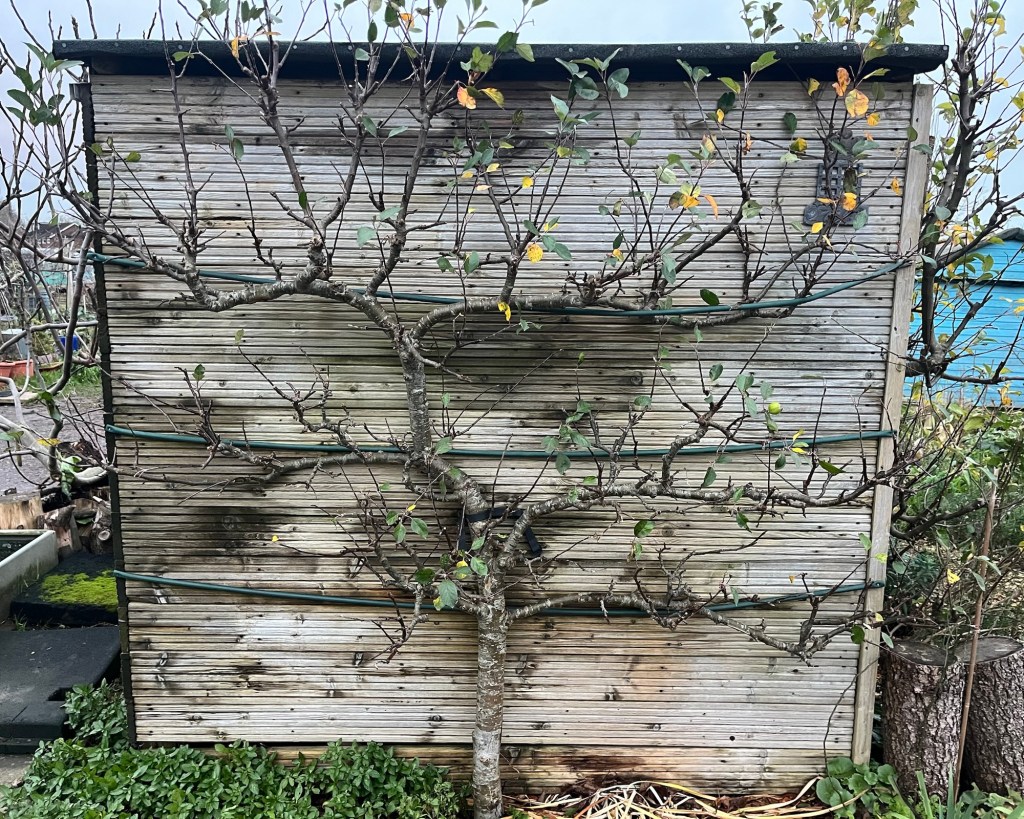
Apple James Grieve, a Scottish dual purpose dessert apple, pruning loosely based on the principles of the espalier technique.

So, an ominous start to the year. January 1st brought a wind chill of -2 degrees c, rain and total cloud cover, very much conditions that are prohibitive to getting outside and tending to the garden as the first indulgence of 2025. In learnt positivity and because expectation is the mother of all disappointment, I saw it as an opportunity to stay put and refine what I have on paper, to indulge thinking about the garden instead. After all it’s fitting with the time of year, to both reflect and project. My hopes for the year? How and when I’ll find the time? Things to do differently? The sowing schedule, the seed list, that kind of thing. That’s if I don’t get distracted by other more necessary things, as is the danger with being at home. Planning it turns out is a real time saver. And if you’re time poor like I am planning is an investment, but this is all sounding very sensible and joyless, you get the idea.

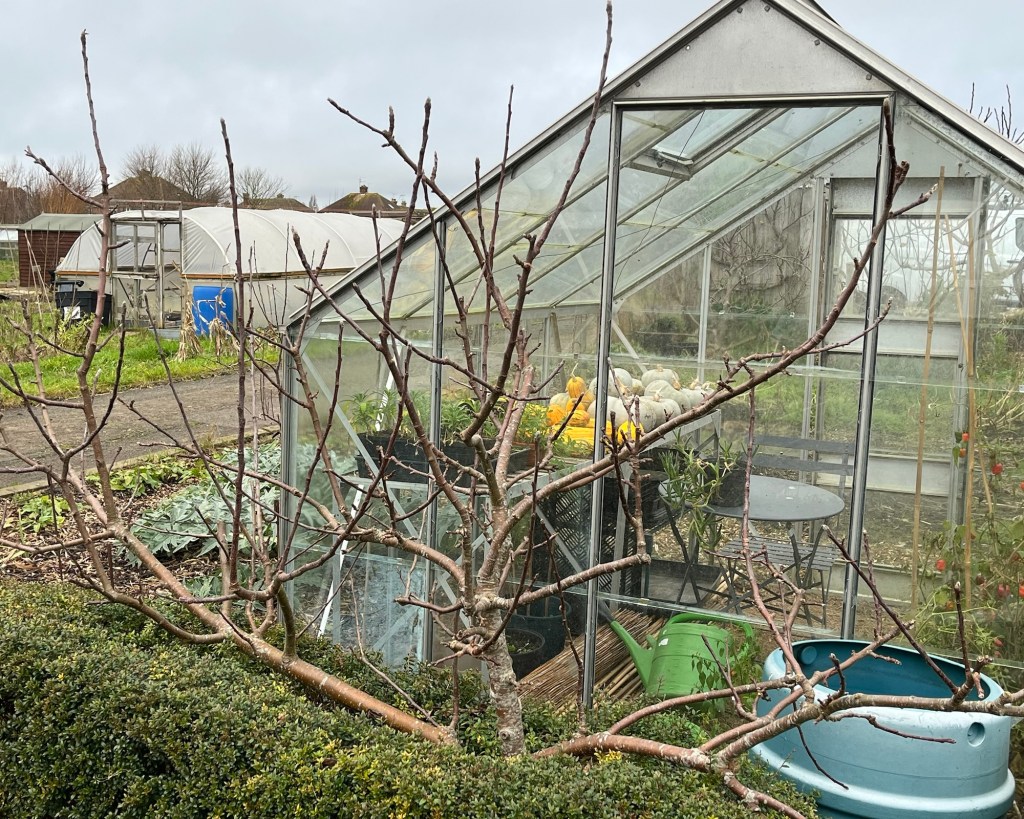
Somewhat chaotic looking Apple Red Devil, it fruits well but the pruning does not conform to text book technique (on purpose).

One of the most enjoyable tasks of the month is pruning the apple trees. There are 10 small trees on the plot, planted around the perimeter and on the south and west sides of the shed. They are all pruned into what would most closely resemble an espalier shape, so as to form a barrier and to reduce their space requirements. I say resemble an espalier as the principle is the same but aesthetically they are more relaxed or informal, somewhere between espalier and fan. This I’ve done deliberately, rightly or wrongly although to look at the trees it might appear as an espalier or fan has been attempted but not achieved. Traditionally formed espalier fruit trees are certainly impressive and practically sensible if a little regimented, so given the rustic make do and mend/reuse and recycle cottage garden ethic I’ve opted for a pruning style that is more relaxed and informal and not one that shouts text book technique. The general pruning principle is the same – heading back and thinning cuts, selecting growth that develops, over growth that detracts from, the desired shape. Heading back refers to reducing the previous seasons growth down to only a few buds, with the aim of developing fruit buds. Thinning cuts are older growth removed for structural reasons, to allow for renewed growth or perhaps to remove the weak or damaged. But, this is not a how to of apple pruning and I’m no expert, however it is certainly rewarding to see young fruit trees develop and to play a part in that.

The particular appeal of gardening, to me at least, and I assume to others also, is that you’re working with something that’s alive. This ongoing endeavour that’s unpredictable and ever changing, where for every action there’s a reaction, at first mysterious but with time and experience becoming knowable and increasingly malleable, the shape of your vision appearing, but slightly differently to how you’d imagined. A microcosm to the macrocosm. With the world outside of the garden too full of darkness and despair, there are those that instinctively seek and find that which balances, to think or write about ideas of refuge and sanctuary in this respect would be more than just hyperbolic rhetoric.

Allotment garden – December

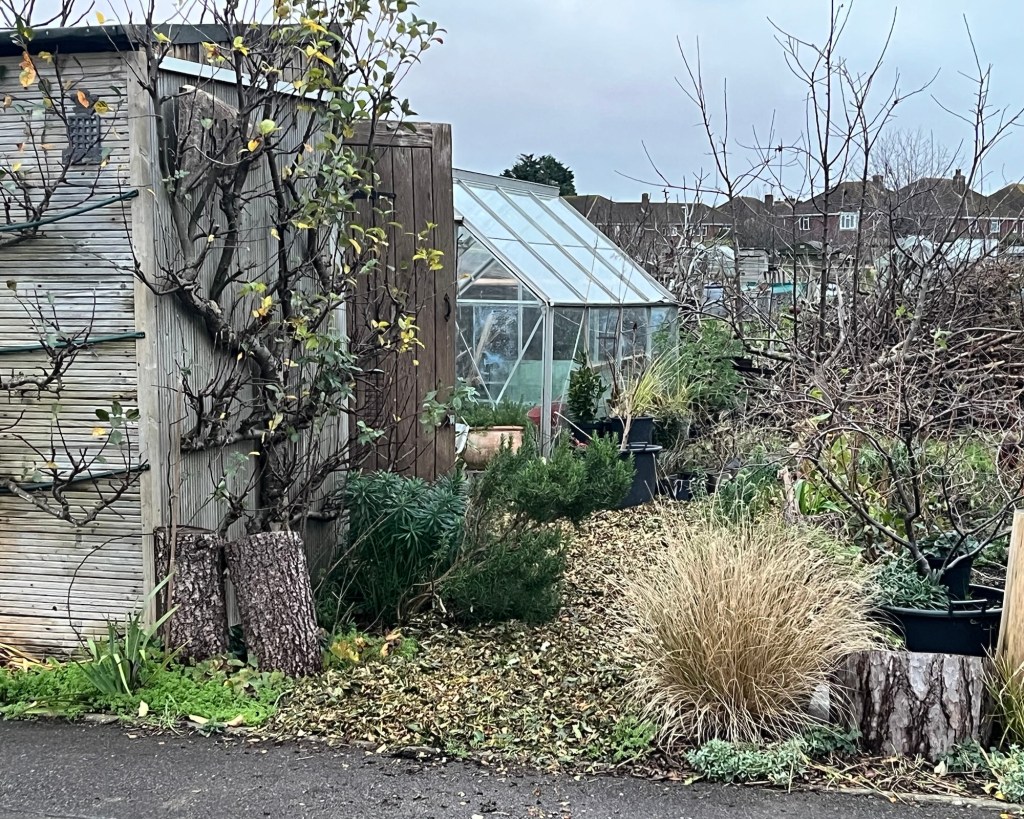
Mixed mild weather at the beginning of the month, some bright days, but always short and getting shorter until the Winter solstice three weeks in and the first day of winter. Grabbed the opportunity to spread fresh woodchip early in the month. The woodchip, which is sporadically delivered to the allotment site, is a byproduct of local tree work. Arborists have the chance to tip their chipped waste for free (they would otherwise have to pay at a green waste recycling centre) whilst allotment holders get to intercept a waste product and recycle it as mulch for pathways, which fits with the spirit of allomenting – reuse and recycle.

Speaking of recycling, the shed, which was erected in April 2015, was majority made of recycled decking boards acquired through the freecycle website. The shed window was salvaged from renovations to the kitchen of our 1950s bungalow, the door I found on the street. Hard to believe it’s practically ten years since. In the intervening time I’ve planted all around the shed, initially with Hemerocallis fulva which has edible flowers and tubers, although I’ve never harvested the tubers I’ve eaten plenty of the flowers. There’s only a small amount of the Hemerocallis left now, the rest of it making way for a mixed planting of ornamental and culinary. The espalier apples are James Grieve and Egremont Russet. Herbs of mint, rosemary, chives and sage. Last year I planted two roses to climb through the apple trees, Rosa ‘Gertrude Jekyll’ from David Austin and a German Macracantha hybrid rose called ‘Raubritter’ which I propagated from hard wood cuttings in 2022/23.

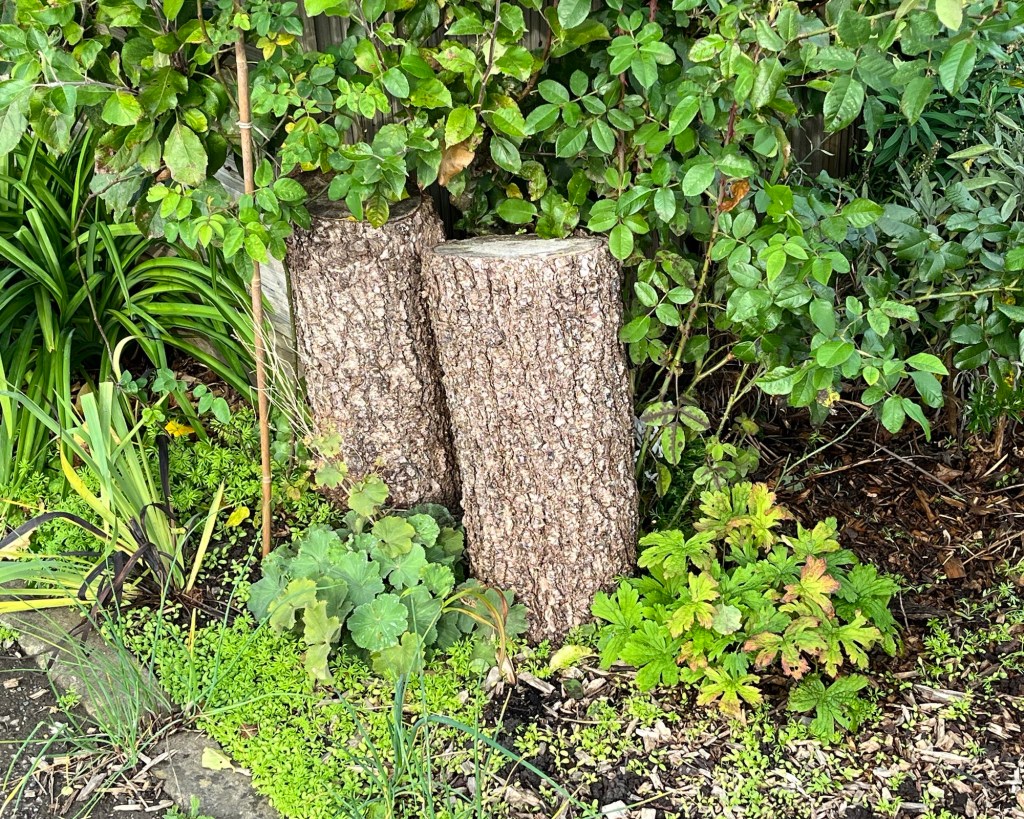
Self seeders play an important role and already in this small area I can see the saucer shaped succulent leaves of Umbilicus rupestris, many feathery seedlings of Nigella damascena, the often weeded out native ‘weed’ Linaria purpurea, winter flowering Primula vulgaris, the patterned foliage of Cyclamen hederifolium, rather tired looking Alchemila mollis and Allium schoenoprasum, and a single fan of spikey grey green leaves that is Sisyrinchium striatum.

I mostly leave things alone during December, it’s dark, damp and grey a lot of the time and there’s preparation for Christmas and tying up loose ends elsewhere before the new year. But next month, January, is for me a month I always look forward to as the view of the year ahead comes into focus.

Allotment garden – November

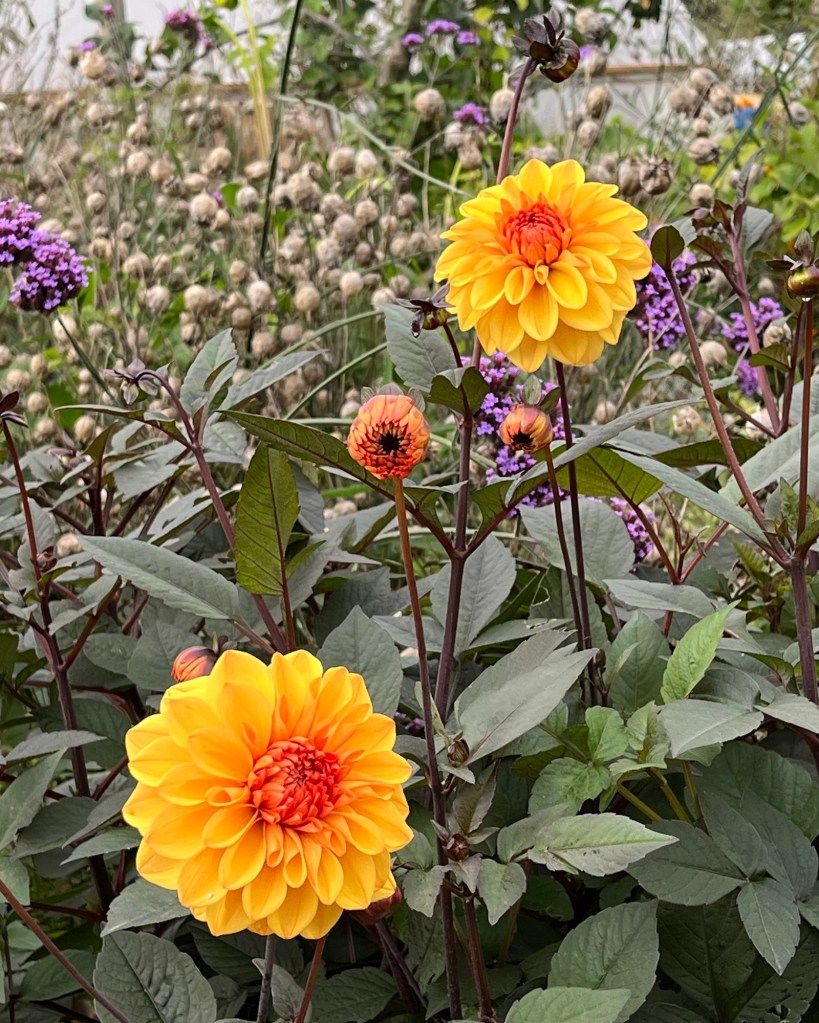
Mild weather continued for the first half of the month, the dahlias in particular looking really good until the temperature dropped out of their comfort zone. On the subject of dahlias there is some debate to be had on whether or not to grow them at all. The first part of the year in my context they really struggled to get going, being constantly mown down by passing slugs in the night, despite my best and sometimes not most friendly attempts to control the situation. It was hugely frustrating and I didn’t see my first dahlia flower until the 27th July! Given that I’m not willing to scatter poison and this being an allotment garden (I’m only occasionally present) I’m forced to think twice about their inclusion in the garden. The case for would suggest that there’s a long tradition of dahlia growing on allotments and that they remain a joyful growing experience, for children and adults alike. Contemporary thinking might point toward there being a sustainability issue and the wisdom of right plant right place highlights the fact that they would not have got this far without significant intervention on my part. But then do we not grow any tender exotics at all, or should we expect to work, to tend to our plants, and hope to reap the rewards? The gardener in me accepts the challenge of succeeding with the plants I choose to grow, like gardeners down the ages, whether it’s Joseph Paxton’s great botanical feat of coaxing Victoria amazonica into flower or the achievements of any number of allotmenteers who frantically nurture young plants planted out too soon to harvestable maturity.

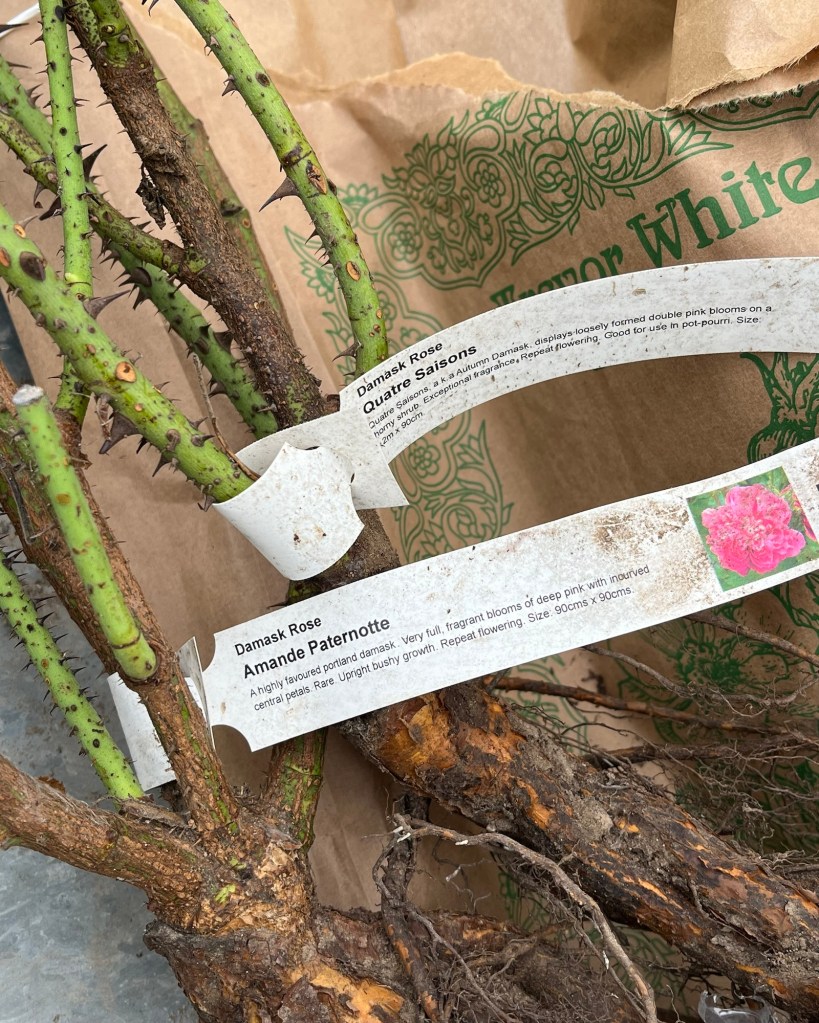
Bare root roses arrived from Trevor White Roses, I planted one and temporarily potted the other. At Mottisfont Abbey in June this year I savoured a Portland Damask rose called Amande Paternotte, which had the best fragrance of all the old roses there on the day. So good that I went back round the garden to smell it again after I’d done a complete circuit. Old rare roses are not so hard to find these days so it’s great to take delivery of these gems and to have them in the garden.

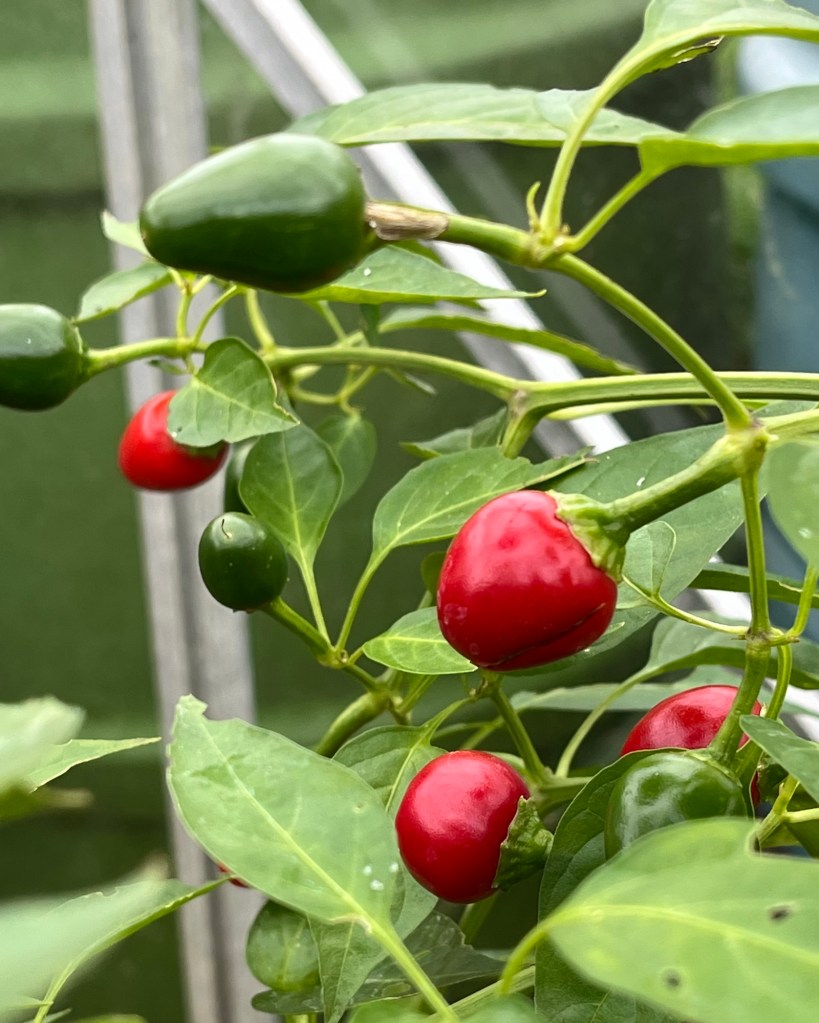
By the end of the month it’s looking like autumn has peaked and winter is now approaching, some rough stormy weather and a cold spell finished off anything tender or half hardy that was hanging on. The garden looks like it’s been battered but there’s still points of interest and produce to take, like the late chillies which are protected in the greenhouse and offering a harvest still.

Allotment garden – October

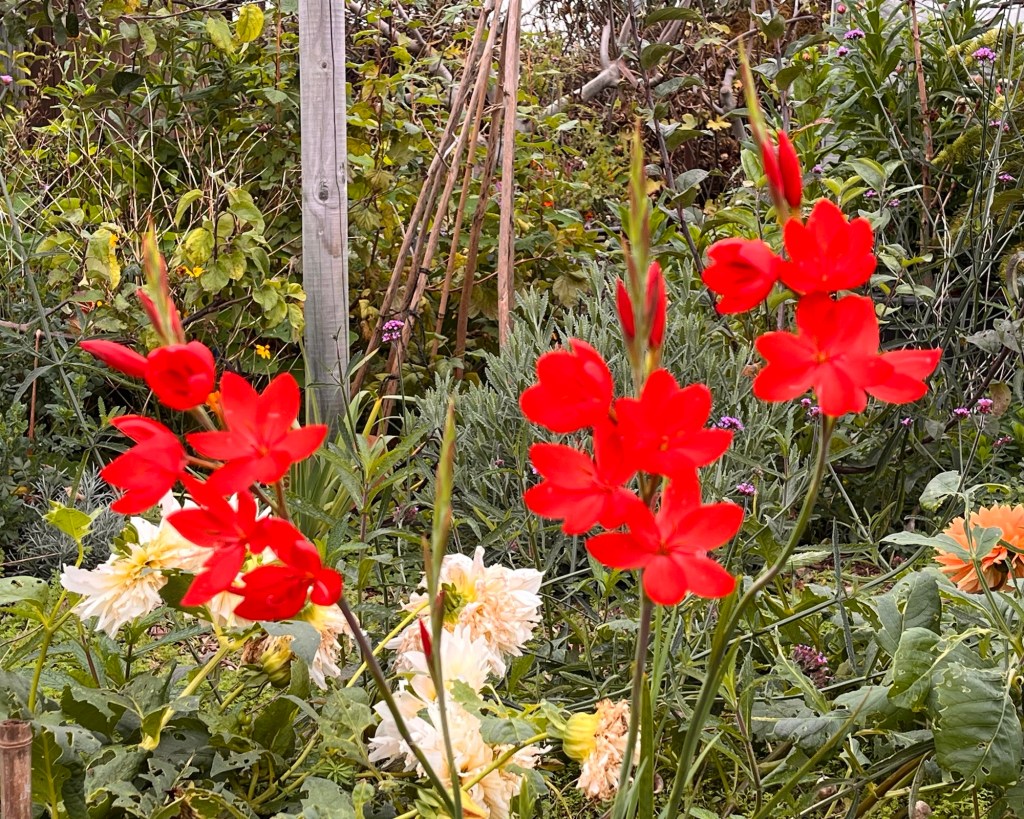
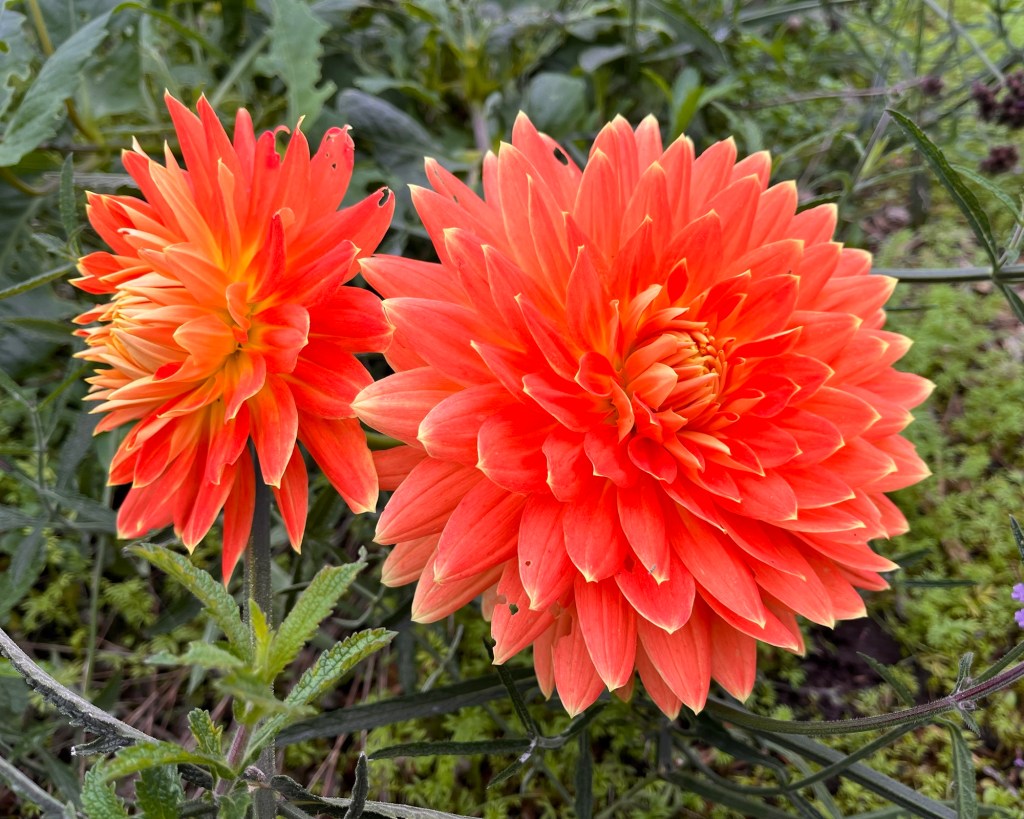
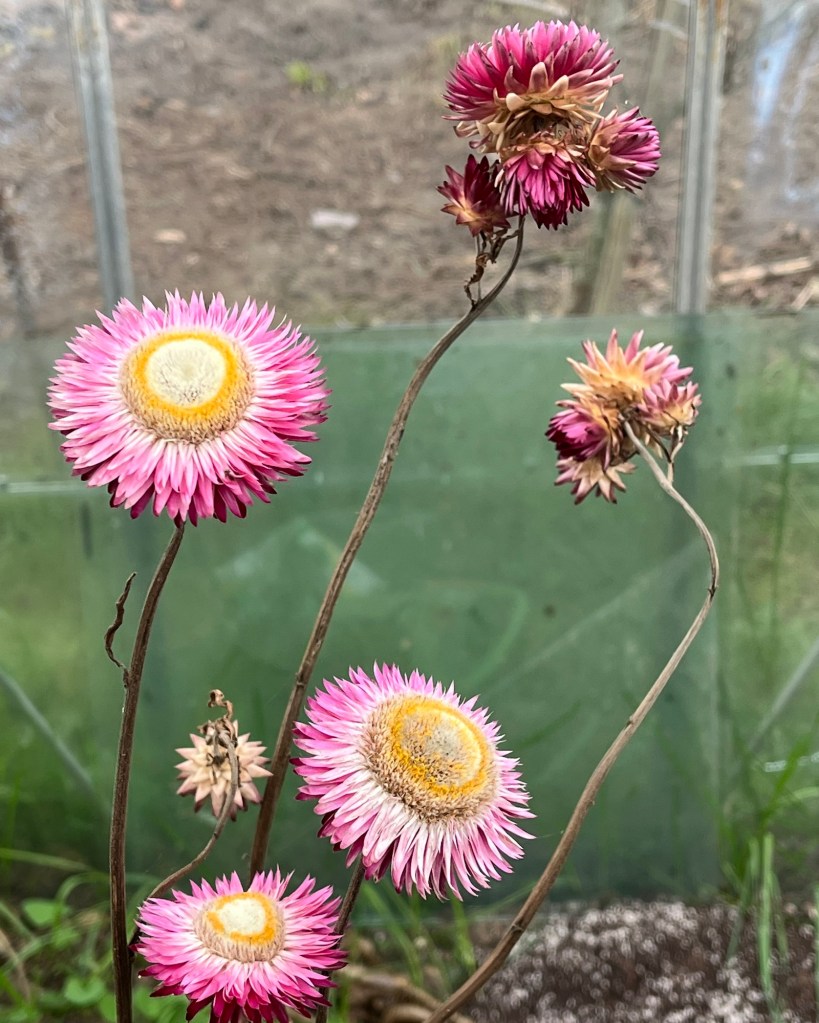
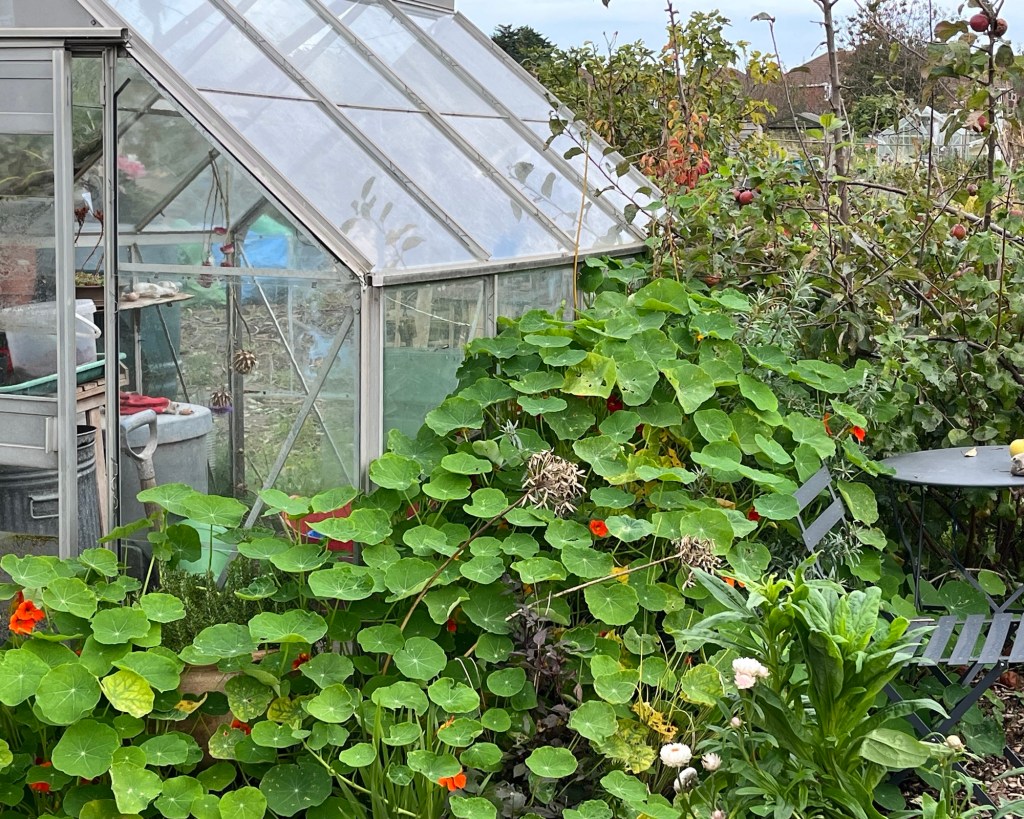
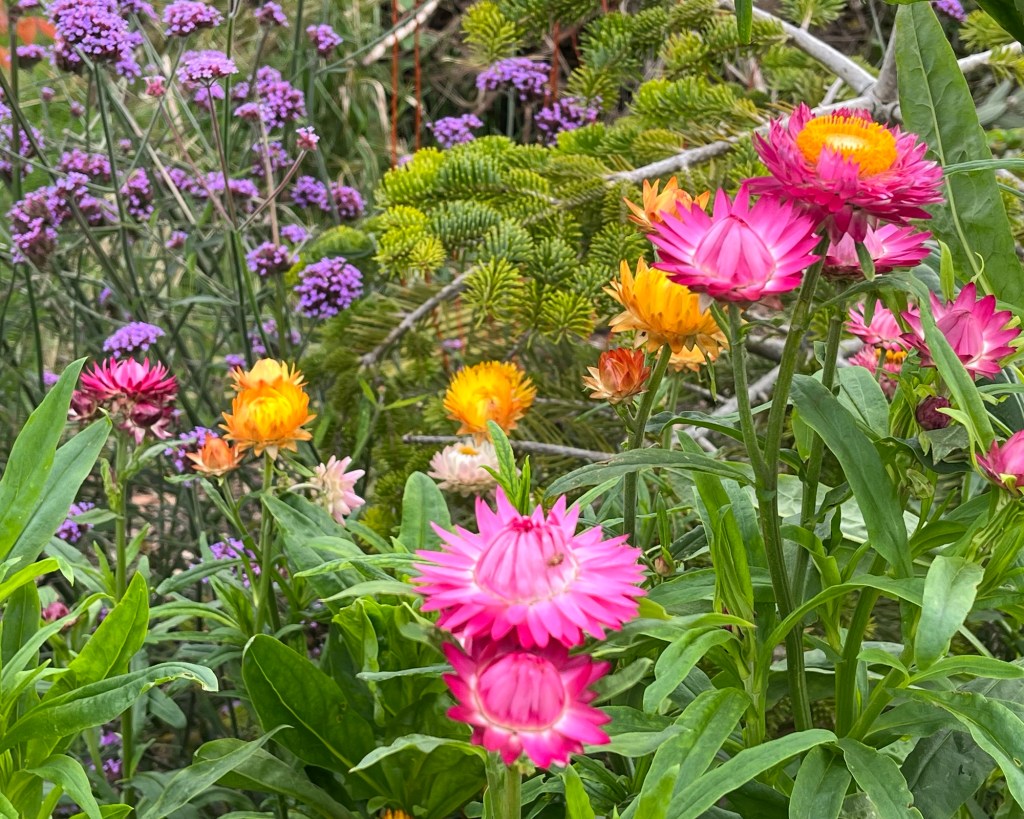
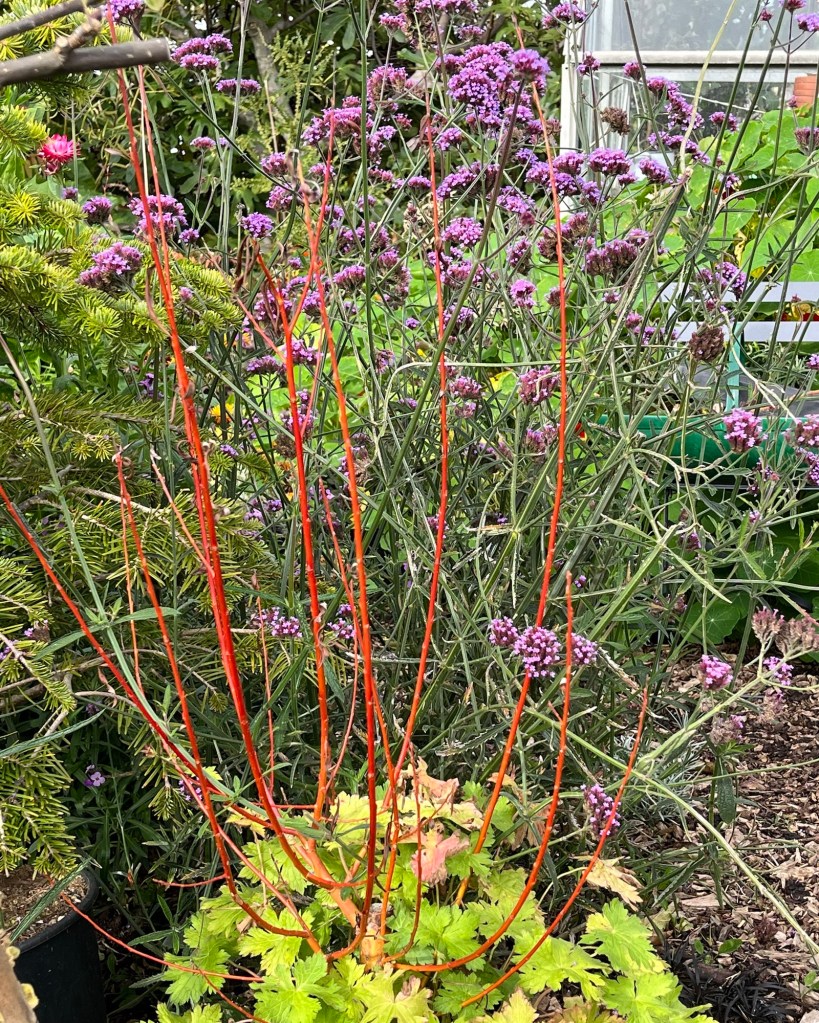
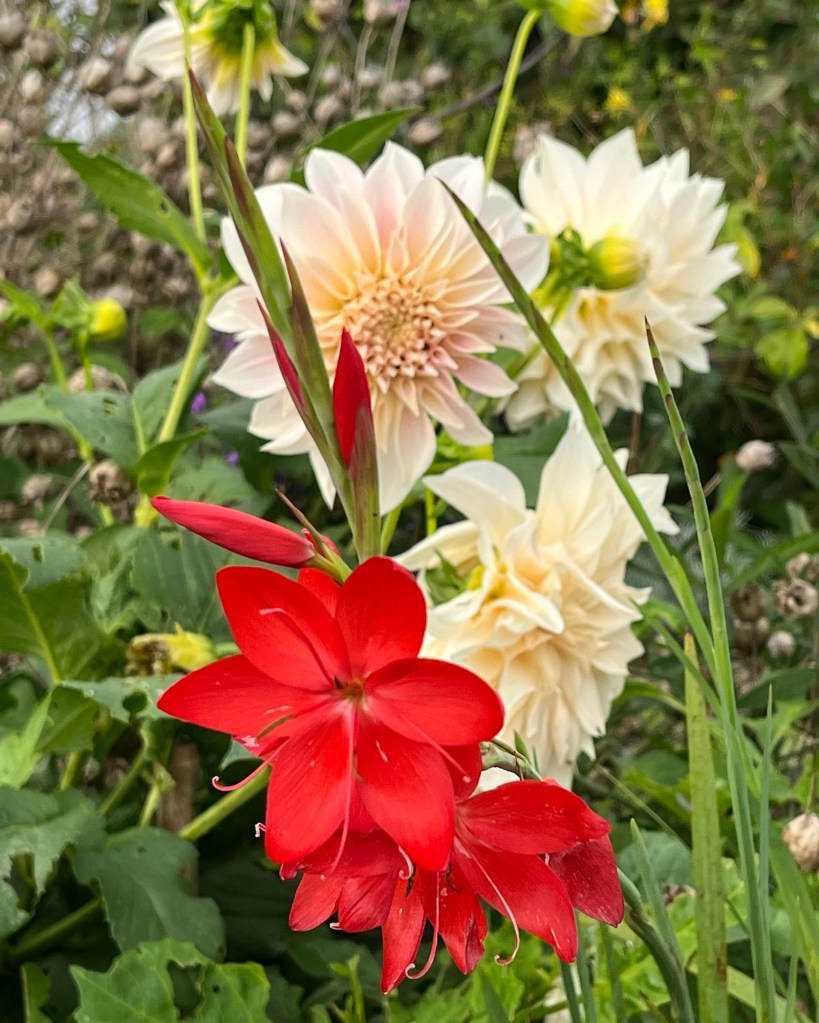
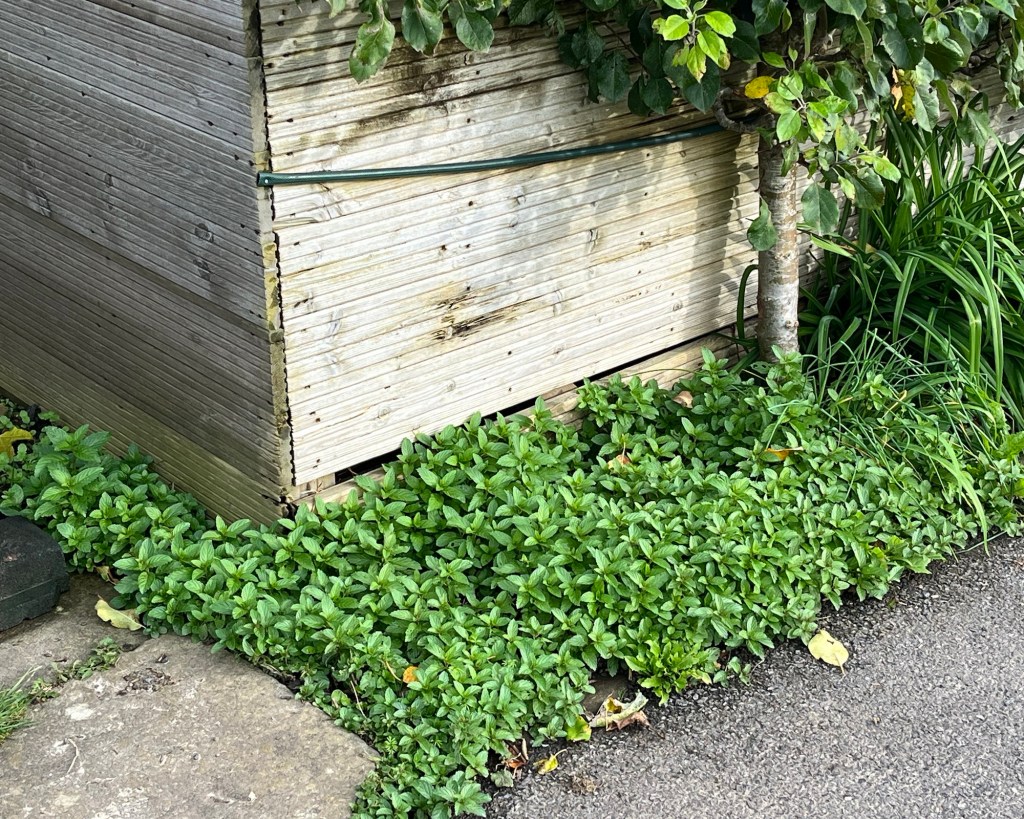
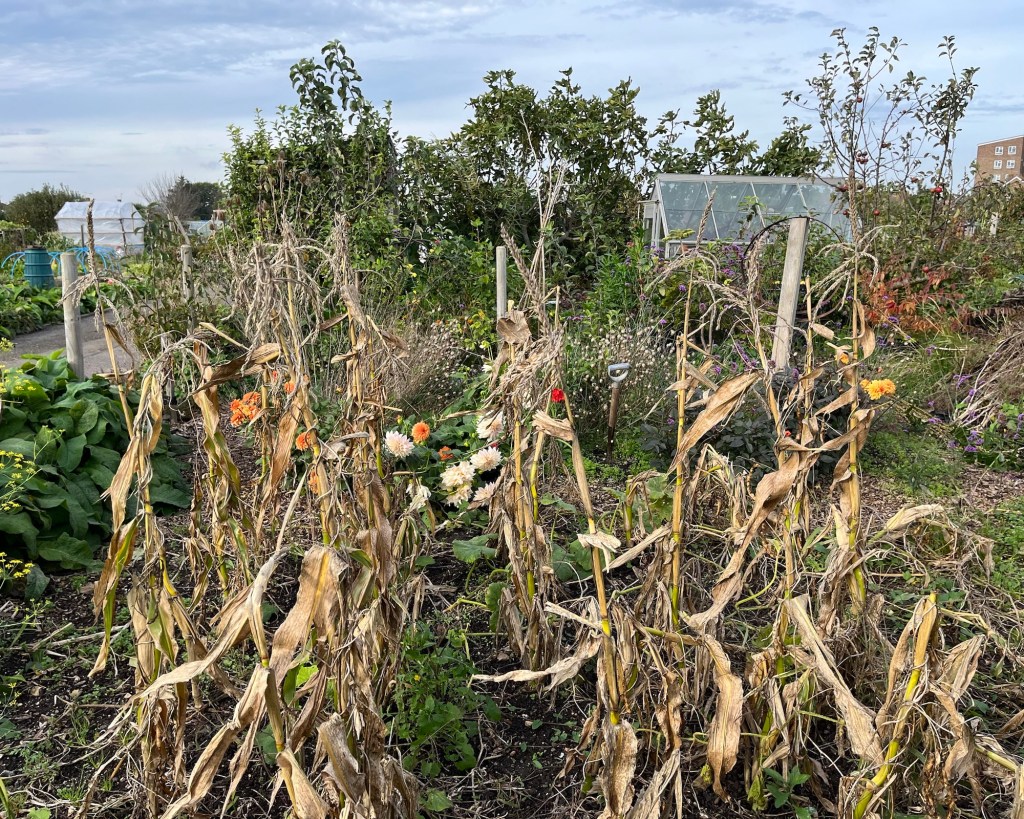
I never intentionally brought in nasturtiums (Tropaeolum majus), arriving on their own somehow, but now each year they successfully swallow the plant bench here and attempt the same on the greenhouse. I thin them quite hard during the summer as they germinate, but by September their vigour is such that I just leave them alone. The garden in September is to be celebrated for its fullness of growth and it’s a time when I begin to relax about tending it and really enjoy the time spent. And so into October and there’s still plenty of colour with many plants flourishing in the mild and moist prospect that the month offers. Check out the dahlias (David Howard, Cafe au lait) never happier than now, Verbena bonariensis and Helichrysum bracteatum continue in flower without hesitation and the crimson of Hesperantha coccinea ‘Major’ is making a welcome appearance now. The mint between the shed and the roadway cut back in late August is fresh and harvestable once again. Curiously a small willow defoliated late September, its stem colour vibrant against a backdrop of green. Nigella damascena, having spilled its seed in August, begins its next cycle, although many of the seedlings will be weeded out or culled by winter weather. There are also browns appearing here and there, most notably the sweetcorn planting which I’ve not been in a rush to clear away this year.

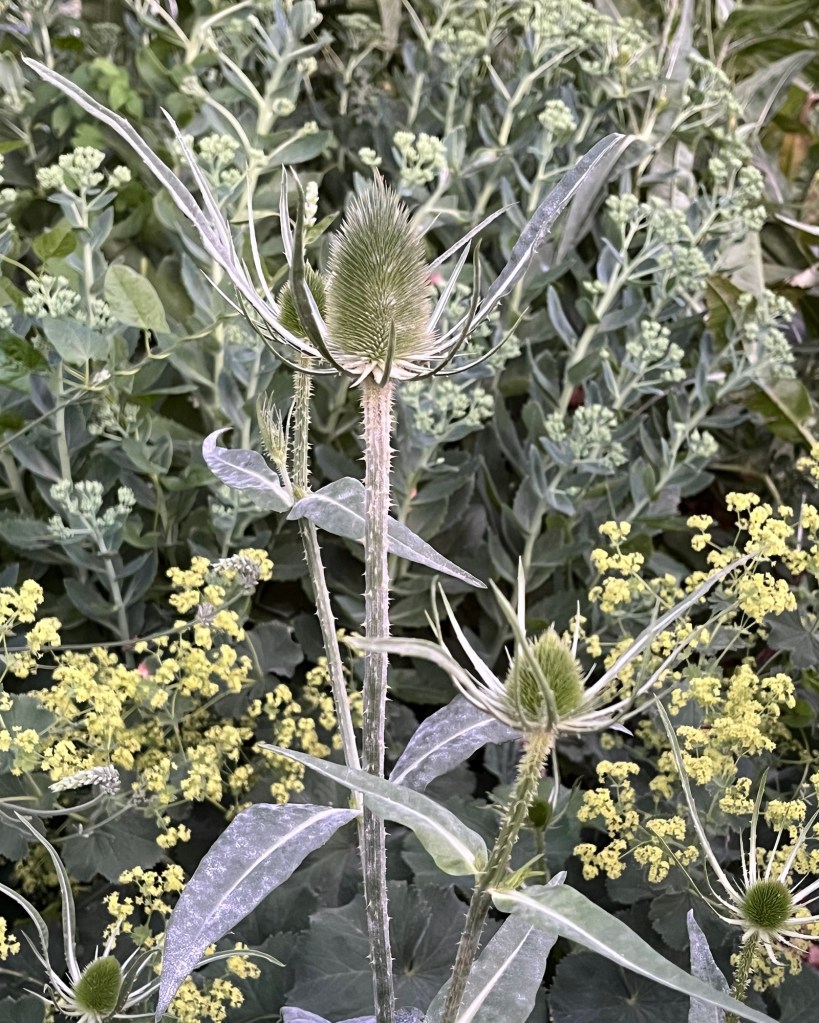
Dipsacus fullonum/Teasel

A robust native (UK) with a biennial habit that’s a good example of a plant that has a life after death, its skeleton and seed heads remain standing over winter, a source of food for seed eating birds. Seen here with good sculptural quality in early summer as the thistle like flower heads form. Spectacular dressed in frost come mid winter, despite looking a bit worn out and weather beaten by this point. Great self seeder.

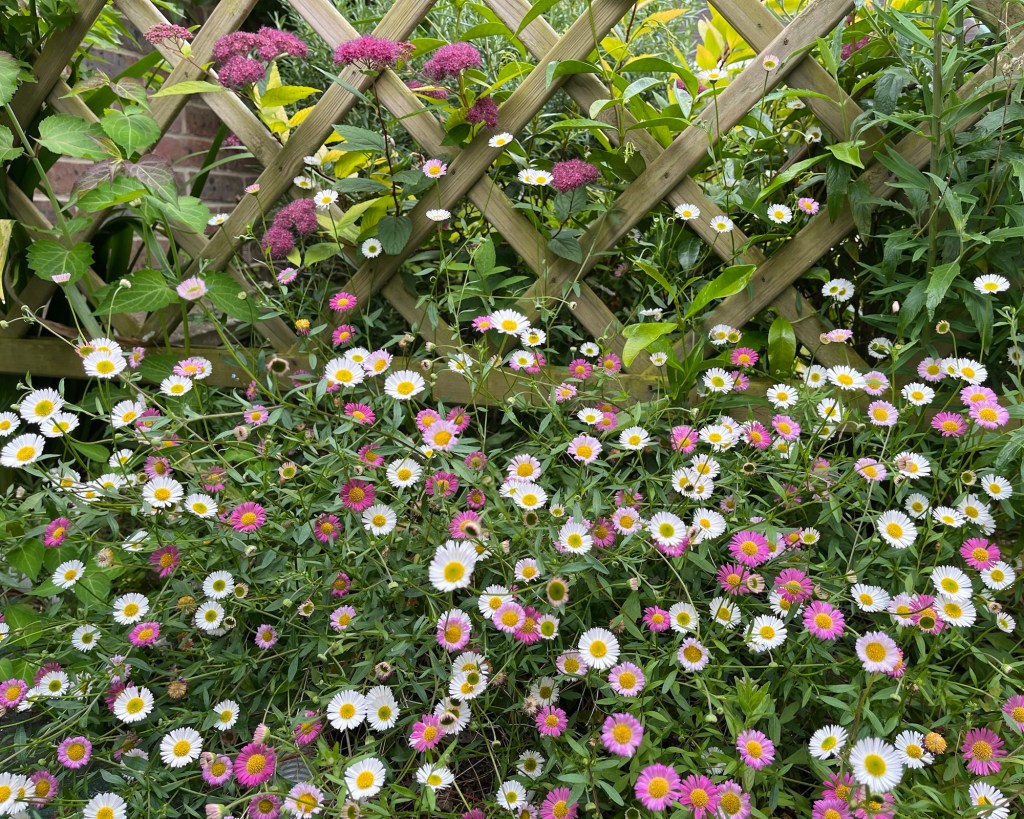
Erigeron karvinskianus/Mexican fleabane

A desirable self seeder, can take a while to seed about and make itself at home, but once happy will become very independent and reliably present. White daisy flowers open and fade to pink almost continuously from spring into the autumn. Will colonise the most unappealing areas, any crevice or crack, given enough time, and should be commended for doing so.

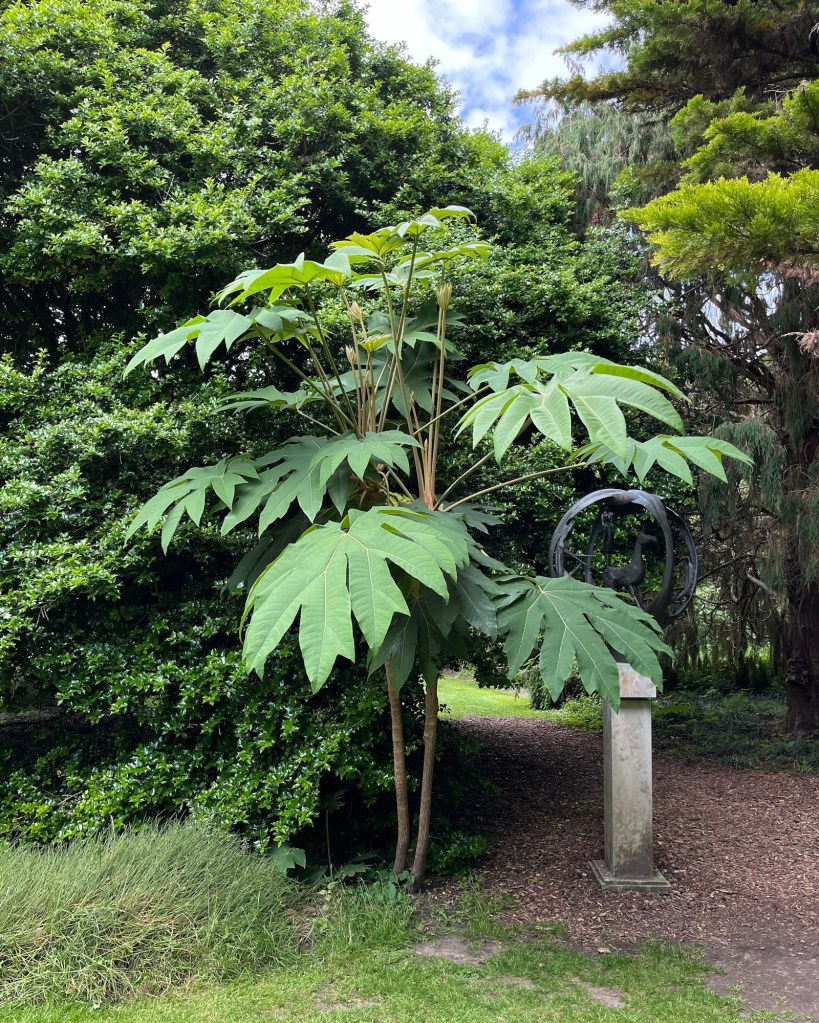
Tetrapanax papyrifer ‘Rex’/Chinese rice paper plant

One of the most spectacular of the hardy exotic plants that are comfortable in the UK climate, and it is hardy, bouncing back with vigour if cut to the ground by frost. Certainly capable of making a woody stem but may behave more like a herbaceous perennial depending on winter conditions. Truly huge leaves that just seem to get bigger and bigger year on year. A real pleasure giving plant.

This specimen seen at the Hillier Gardens in Hampshire, UK. Still a junior at 10 ft tall.

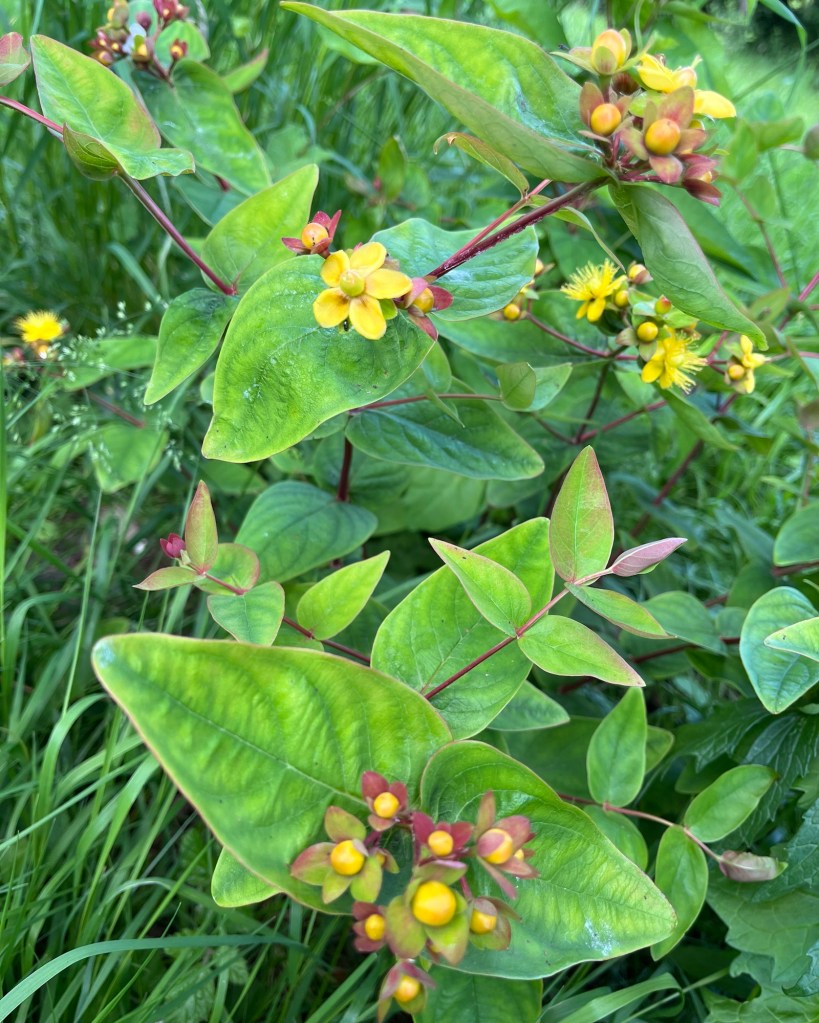
Hypericum androsaemum/Tutsan

Mostly overlooked and frequently weeded out, Hypericum androsaemum is a good example of a plant that for most of the year is a bit drab, unremarkable even, but it has its moment in June with fresh stalkless leaf growth and the appearance of flowers branched in cymes. Native and widespread. Harmful if eaten. Good for native wildlife providing food for several larval stage moth species.

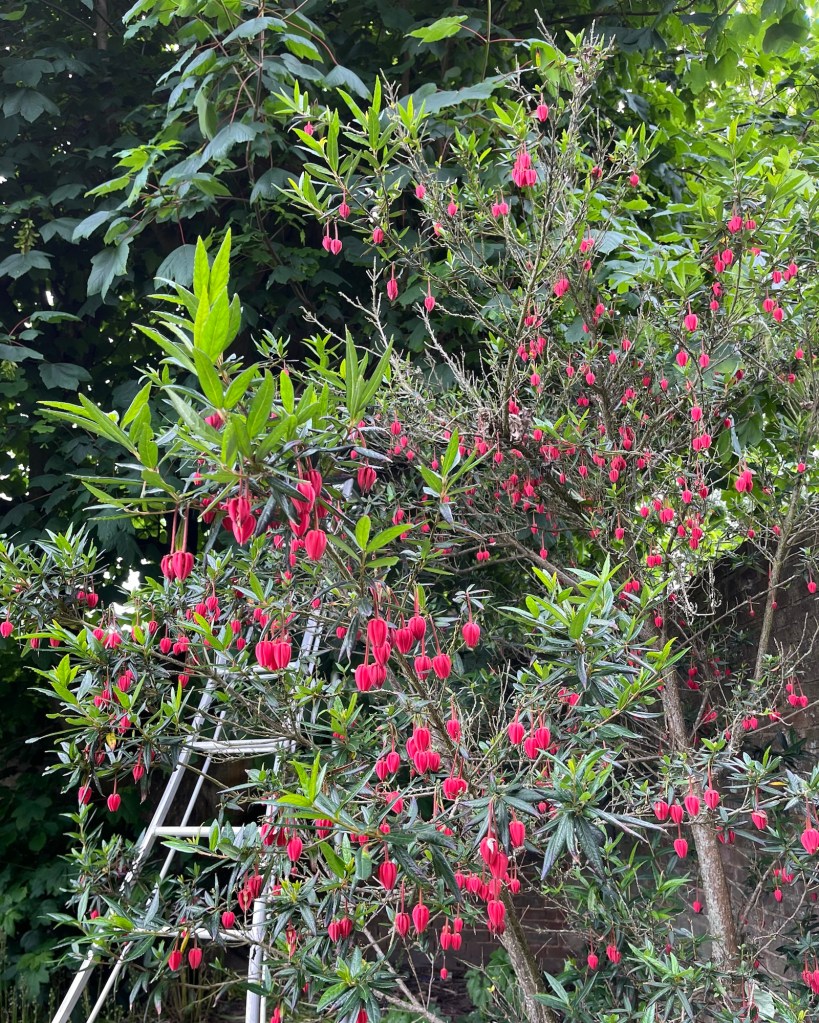
Crinodendron hookerianum/Chilian Lantern tree

Of South American origin this evergreen forest tree has distinctive fleshy red ‘lantern’ flowers now at the end of May and into June. It’s said to avoid C. hookerianum in wildlife friendly gardens as the flower morphology renders them inaccessible to indigenous insect life. In its native range it is pollinated by hummingbirds, hence the curious shape and texture of the flower. Eye catching at least if not insect friendly. Needs little or no pruning. Happy enough in shade or as an understory plant.